

From Passive Care to Precision Rehabilitation: 2026-2027 Trends in Hong Kong Gerontechnology and Smart Ageing at Home
Hong Kong's ageing population is reshaping rehabilitation
Hong Kong is facing the challenge of rapid population ageing. Gerontechnology refers to innovative products and services that combine modern technology with the care needs of older adults. In the past, rehabilitation relied heavily on residential care homes and clinics, and was constrained by frontline healthcare manpower. As we enter 2026, the development of gerontechnology is moving quickly from simple assistive-device support toward a smart rehabilitation ecosystem powered by AI, XR, and big data. The future direction is a full transition from "passive care" to "active and personalized rehabilitation" built on evidence-based practice.

Trend 1: AI-personalized rehabilitation and dynamic difficulty adjustment (DDA)
As artificial intelligence matures, AI physiotherapy and AI occupational therapy are rapidly entering everyday clinical and social service settings. Traditional rehabilitation exercises often discourage older adults or become boring because difficulty levels are too rigid.
AI-generated training content and DDA: In recent years, academia has widely applied Dynamic Difficulty Adjustment (DDA) to rehabilitation systems. Authoritative systematic reviews note that DDA algorithms combining physiological data and performance data can keep users within the "optimal challenge zone," significantly improving motivation and engagement among older adults.
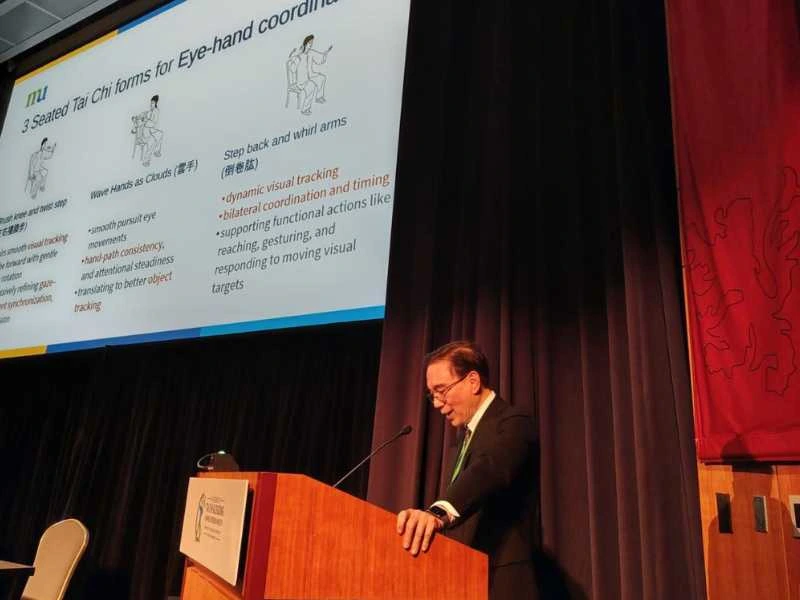
Local and international practice: Mature applications are already available in the market. For example, MOTIVE FORCE's Alpha Pro elderly exercise system was showcased at a Harvard Medical School seminar in May 2026, demonstrating how computer vision can capture patient movement in real time and use DDA algorithms to fine-tune training difficulty instantly.
Personalized lesson plans and progress analysis: For stroke patients or people with dementia, AI can use machine learning to identify compensatory muscle movements, provide real-time voice feedback, and generate tailored progressive rehabilitation programs.
Trend 2: Home-based rehabilitation becomes mainstream with top-tier clinical evidence
Ageing at home is a core goal of Hong Kong's elderly care policy. To help older adults stay safely at home, innovative technology equipment and telemedicine support are essential.
Non-inferiority evidence for telerehabilitation: A systematic review and meta-analysis published in the Q1 gerontology journal Age and Ageing in 2023 (Wicks et al., 2023) clearly demonstrated that therapist-led telerehabilitation for older adults is non-inferior to traditional face-to-face treatment in improving joint range of motion and muscle strength, while also reducing healthcare service costs.
Hybrid rehab: Combining in-person clinic treatment with online home training can increase training frequency in the most cost-effective way.
Home exercise: Interactive home fall-prevention and strength-training systems make self-directed exercise more engaging and easier to maintain regularly.
Trend 3: XR and VR rehabilitation move toward wider adoption and neuroplasticity
Immersive virtual reality rehabilitation (XR/VR) is no longer a technology gimmick. Recent systematic reviews and clinical trials have confirmed that VR rehabilitation has strong clinical value.
IADL and cognitive training: According to academic reviews in Q1 neuroscience journals such as Frontiers in Aging Neuroscience (Buele & Palacios-Navarro, 2024), VR training based on instrumental activities of daily living (IADL), such as simulated cooking, financial management, public transport use, and road crossing, can activate specific brain regions and significantly improve executive function and memory in older adults.
High ecological validity: The literature further emphasizes that multitask training in VR can help older adults with cognitive impairment transfer skills learned in virtual environments seamlessly into real life and regain independence.
Community training: VR enables older adults with limited mobility to virtually revisit familiar communities, encouraging social interaction and reducing loneliness.
Trend 4: Data-driven rehabilitation
Traditional rehabilitation assessment often relies on therapists' subjective rating scales. Future rehabilitation will move toward full data-driven management.
Automated reports: Systems automatically generate objective data analysis after each training session, such as millisecond-level reaction time and joint range of motion.
Outcome tracking: Long-term rehabilitation curves support multidisciplinary teams, including OTs, PTs, and doctors, in jointly adjusting treatment plans.
ROI: Organizations and families can clearly see the physical and psychological benefits of rehabilitation investment, as well as future savings in potential medical expenses.
An occupational therapist's view: Will AI replace therapists?

The future will not be AI replacing therapists, but AI augmenting therapists' capabilities.
In the face of the technology wave, people often ask: "Will AI replace occupational therapists?" A landmark article published in 2025 in the Q1 occupational therapy journal American Journal of Occupational Therapy (AJOT) (Jozkowski, 2025) gives a clear answer: AI has become necessary for clinical practice and policy, and can effectively handle large-scale data, movement monitoring, and difficulty adjustment. However, therapists' empathy, interpersonal interaction, high-level clinical reasoning, and deep understanding of patients' life contexts can never be replaced by technology. Technology is a powerful enabling tool that gives therapists more time to provide professional intervention with human warmth.
About the author:

Mr. Vic Wong
Registered Occupational Therapist | Registered Social Worker | Gerontechnology Expert
Mr. Wong holds dual professional recognition as a registered occupational therapist and registered social worker, and previously served as a senior occupational therapist at a large social welfare organization. With a deep understanding of industry needs and technology applications, he guides practitioners from a professional clinical perspective to understand the key criteria for selecting AI tools and comprehensively improve service outcomes and quality.
References
1. Wicks, M., Dennett, A. M., & Peiris, C. L. (2023). Physiotherapist-led, exercise-based telerehabilitation for older adults improves patient and health service outcomes: a systematic review and meta-analysis. Age and Ageing, 52(11), afad207. https://doi.org/10.1093/ageing/afad207
2. Jozkowski, A. C. (2025). The Issue Is—Artificial intelligence and occupational therapy: From emerging occupation to educational, practice, and policy imperative. American Journal of Occupational Therapy, 79(6), 7906347100. https://doi.org/10.5014/ajot.2025.051283
3. Buele, J., & Palacios-Navarro, G. (2024). Virtual reality applications based on instrumental activities of daily living (iADLs) for cognitive intervention in older adults: a systematic review. Frontiers in Aging Neuroscience.
4. Andrade, A., et al. (2021). User Experience With Dynamic Difficulty Adjustment Methods for an Affective Exergame: Comparative Laboratory-Based Study. JMIR Serious Games, 9(2), e25771. https://doi.org/10.2196/25771